
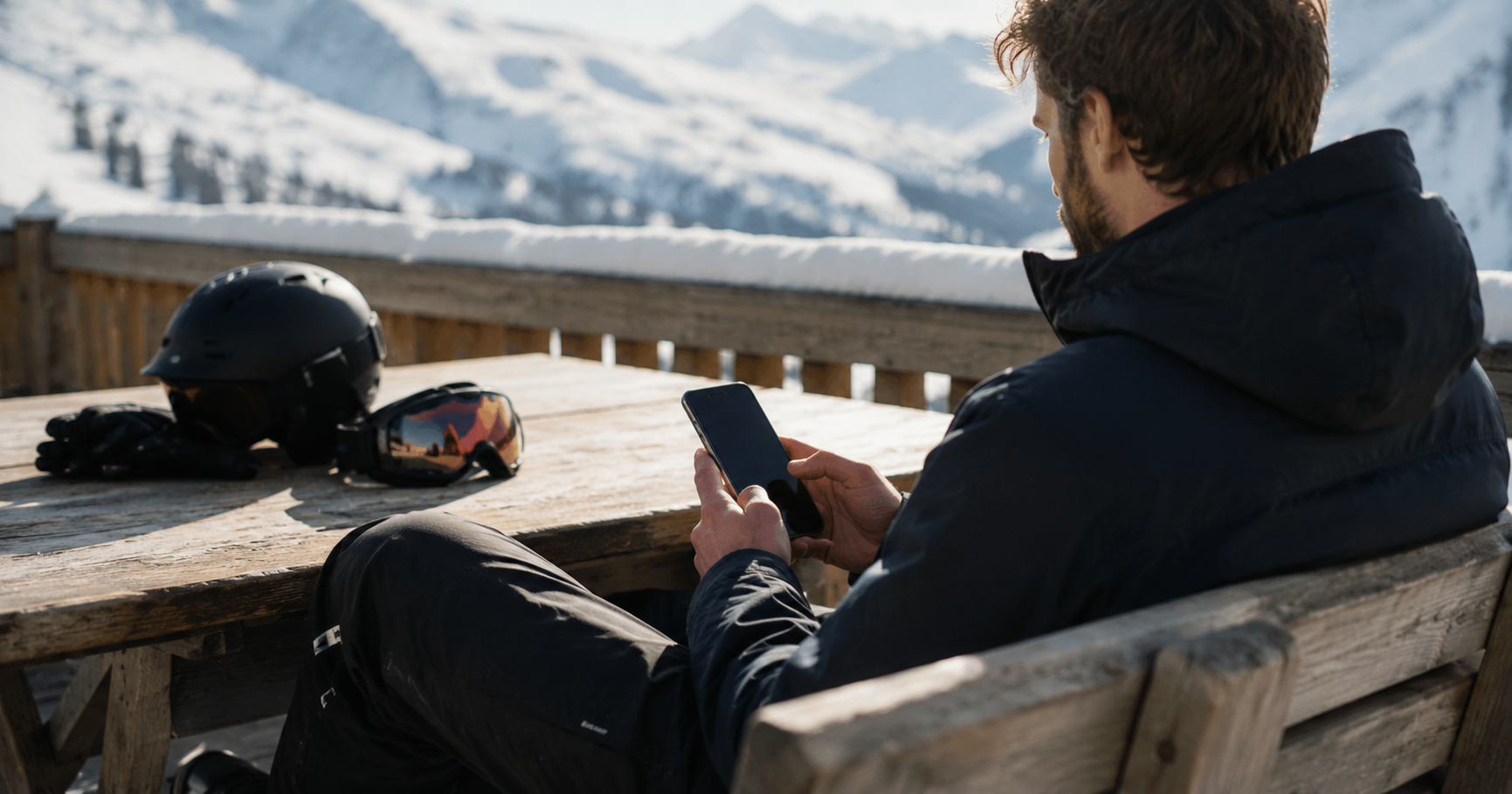
First lift, phone in your jacket pocket, zipper closed. From there on, ski tracking should just run, without you thinking about your battery.
That’s what we’ve spent the last few months on. The piece of software that records where you are while you ride? We rebuilt it from scratch, separately for Android and iOS. From the outside the app looks the same. Inside, almost nothing is the way it was.
Why we replaced something that worked
Until now we used an off-the-shelf building block for this, the same one plenty of tracking apps rely on. It did its job for years.
Only, we could barely adapt it. We could read its code, but changing it was hard to impossible. So we kept building around it. And every time we wanted to start something new, we ran into the same wall: we simply couldn’t reach the place where it needed to happen.
At some point it was clear: we had to build this ourselves.
What the new ski tracking does for your battery
Your phone is in your pocket while you ride. Screen off, and you don’t look at it all morning.
The old solution still handed every single position straight to the visible part of the app: the map, the stats, the display. A day on the mountain adds up to many thousands of positions. For every one of them the app redrew your track and recalculated elevation, speed and distance. For a black screen in a jacket pocket.
That doesn’t happen anymore. While the app is in the background, your positions go straight into storage on your device. The calculating and drawing waits until you actually look. Tracking is just as precise as before. It simply takes far less work. And on the mountain, that work is exactly what’s missing from your battery by evening.
And when you open the app back up?
Lunch break, phone out, app open. Now SnowTrack has to catch up on the last three hours.
It used to do that by replaying every stored position one at a time, with all the number-crunching in between. On a long session the app would sit frozen for seconds: no taps, no response, just a still image. It felt like a crash. And that’s exactly how you reported it to us.
Now the app catches up in one go: read everything at once, redraw once, done. Most of the time you’re back before you even notice. And if it does take a moment, you’ll see a quick “Loading your recording…” with a progress count, instead of wondering whether the app just died on you.
Two honest notes
We’re deliberately not putting a percentage on this. How much battery you actually save comes down to your phone, how long your day is, and how often you pull it out of your pocket.
What we can say: the app does noticeably less work while tracking than it used to.
One more thing: we tested on every device we could get our hands on. But there are far more phones out there than fit in our office. If something isn’t right on yours, please tell us before you leave a bad review: feedback portal. We can reply to a review, sure. But it almost never tells us what actually happened on your phone: which device, which version, which moment. A report does. And then we’ll sort it out as fast and as thoroughly as we can.
The groundwork for what’s next
The second reason for the rebuild wasn’t about today, it was about tomorrow. The features we’re building next kept breaking their teeth on the old solution. Not because the ideas were too ambitious, but because we couldn’t get at the right places technically.
We’re not saying yet what’s coming. Only this: on the old foundation, it wouldn’t have been possible.
What do you need to do? Nothing.
Grab the update and that’s it. Your existing sessions and stats stay exactly as they are. We changed how tracking works, not what gets recorded.
Season’s coming. Get the update, wax your skis. See you out there. ⛷️